Friday, March 23, 2012

From the Great Sea to the Sea of Galilee

The Jezreel valley from Mt. Carmel


Half way through the semester and its been a thrill.


Sorry everyone for not updating more, school and life is getting kinda busy now. But everything is great and i'm having fun, too.
From the last tim I posted till today, I went on a tour of the Church of the Holy Sepulcher with my Church of the East class, traveled around the Judean Desert for my Second Temple class, and coming back from a four day study trip around the Jezreel, Galilee, Golan, region of Israel. Here is some of my reports about the Galilee trip. 

Roman Aquaduct at Caesarea

Day One of Galilee Field Study:
Mt. Carmel, Caesarea, Megiddo
Today, the physical settings class toured the northern section of Israel focusing around the Shephelah of Galilee; from the coast of the Mediterranean Sea at Caesarea to Jezreel Valley. In the morning our first stop was at the ancient port city of Caesarea. This city was the main focal point of Roman influence and power on the land during the time of Herod, which Herod, himself built. King Herod built this fantastic engineering marvel to show the Roman emperor that he and his people are loyal to Rome and that he wanted to make Rome see Judea as a friendly client state.  We also learned that Herod wanted to build a new Greco-Roman city on the coast in the middle of Joppa and Acco Ptolemais. He did this building because this would cement his claim as ruler of the Judeans, and to show Caesar that he is serious about ruling and holding Roman loyalty high. The coast, though, is not a good site to see for the people of the hill country. Even in scripture they fear the vast unknown of the sea; such as in Psalm 107: 20-27, Isaiah 57:19 which states the sea is a wicked thing, and it brings terrible things to this land. This fear of the sea also continues on to the stories of Jonah, Noah, the parting of the Red Sea, and even in Revelation, which describes there being no sea, which means no more wickedness.  This port city is also where the story of Acts 9:31 takes place which sets the stage for the spreading of Christianity to the “ends of the earth”.  When Paul is ordered to the palace that has a fresh water pool surrounded by the sea, where the centurion, Cornelius of the Italian Squadron converts along with his family to Christianity in this very pagan oriented and westernized city. This same site is where Paul was to be trialed for his wrong doings by Agrippa II and the high priest. Since he is in a Roman city and being a Roman citizen, he has the right to travel for free to Rome for trial. Which he takes and this marks his last journey, ending up on Malta. This site was perhaps one of my favorite sites by seeing the theater, the hippodrome, and the remains of the palace. However what really made it a favorite site were the above and covered lower aqueducts. Being a history major who might specialize in influence and power of Rome from republic to empire this trip was really fascinating.
Our class then toured on to Mt. Carmel where we got to climb to the top where the Carmelite monks had a monastery. At this place we took time to have a horizon look of the whole region of the Jezreel Valley and the Shephelah of Galilee.  We were able to see many of the physical markers of the region; such as Mount Tabor, Megiddo, the Sea, valleys forming the Joknean Pass and the Megiddo Pass, etc. This was also the site where Elijah fought for God against the prophets of Baal, during the test fo the gods.  It was interesting to learn to that both Baal is seen as a god holding a lightning bolt, and prophets asked Baal to shot a bolt down to start their wood on fire. The Elijah did the same thing only with wet wood and God started the wet wood on fire using a lightening bolt from heaven. From there we then visited the ruins of the city of Megiddo. I was personally looking forward to learn about this site as being the future battlefield of the Last Battle of the Ages, but I learned differently. The city was a administrative, economic, and militaristic city but not that important to have such a powerful title. Also this site is considered as being the cradle of biblical archaeology and the laboratory of the modern research methods. 

                           
The Cardo of the city of Zippori (Sepphoris)

The Mona Lisa of the Middle East

Beth Shean (Scythopolis)


Sepphoris, Nazareth Ridge, Scythopolis

Today was a wonderful day from a cool brisk windy morning to a wonderful hot calm evening in the Galilee region.  Our first place of visit was in the capitol of Galilee, Sepphoris. This city was the center of Hellenization in the region and in Judea, and the arrival of many Greco-Roman culture brought the even the synagogues to be built with pagan artwork such as zodiac mosaics; that has graven images of people and animals. Some of the mosaics in the floor of the 4th century synagogue are the two lions of Judah, a menorah, rams horns, and also Sarah at the door of the tent. The Mosaic artwork was an import from the West by Herod the Great who loved the Greco-Roman culture. Herod only used three colored stones for his mosaics and some of the mansions later on used even more of colorful stones, showing how wealthy the people were in this city.  The use of the pagan art was not as much of the people becoming pagan its more of that they like the color and patterns, as well as assimilating into the Hellenized world.  Which is similar to Christians today using evergreens as Christmas trees. In the city there was a Roman theater that looked to the North with the background being the Natophe Valley and Mount Hermon.
We then traveled to the Nazareth Ridge where we did a horizon overlook of the whole Jezreel Valley all while a Roman Catholic celebration was happening and our group was in the strong wind on the rocky outcrops of the Jumping Cliff before lunch. We discussed the historical and Biblical events that occurred in the and around the Jezreel valley. This included some figures of the Bible such as Jonah, King Saul, Gideon, etc.  What got me curious was the connection of the Old Testament prophets and royalty being created again and in a better form by Jesus Christ, for him to fulfill the prophecy. 
The class then traveled to Scythopolis or also known as Beth-Shean. This was my favorite site of the day, with great Roman, Greek and even Egyptian history and structures in this concentered area.  The city was taken by the Egyptians under Thutmose III and made it his capitol of the Palestine province. From this rule Egypt had a huge influence here and Palestine was the land between for the many trade routes; and so the Egyptians want the city for this reason. Also I learned that in the region of the Jezreel Valley King Saul and his sons fought against the Philistines near Mount Morah; the two armies fought and the Israelites fled with their king and princes dead. Later the Philistines took the bodies of the Saul and his sons to have them be hung at on the walls of Beth-Shean. But this region was fought over, over the many years. Going from the Egyptian hands, to Assyrian, Greek, and Roman as a highly valued trade center. During the Greek and Roman period this city was known as Scythopolis. The city was remade into a Greek colony from Alexander the Great’s troops after the war, and was then taken by the roman general, Pompey, which he then incorporated it into the district of Decapolis (the ten cities district), these cities were the most Greco influenced Levantine cities of the Roman Empire. What was really interesting was that this city is the city of Galilee of the nations and that its been inhabited for the last 4000 years. 


Gadot Lookout, Hazor, Dan, Caesarea Philippi, Banis Waterfall, Mount Betal

The third day of our Galilee Field Study trip, the group first visited the Gadot lookout which was a site of a Israeli- Syrian tank battlefield, all around the site and everywhere in the Golan region there are still active mine fields and in the background we can see Mount Hermon with its snow-capped tops. The site that is the memorial of the battle still has the dugouts, the bunkers, and the tank barriers along with a tomb of the soldiers. From this place of honor and valor for ones country we trekked on to the ancient Golan city of Hazor. During the time of Joshua this city was part of the a confederation of equally-sized Canaanite cities; spanning about 200 acres total with the upper city being 20 acres; a huge site this city was. This town was considered a society that is consistent to other Mesopotamian cities, being the southernmost of the northernmost trade cities on the routes. The main trade for the people in Hazor was the metal tin and copper. These two metals were the key ingredients to make bronze for weapons, ornaments, and bowls. The trade happened from the port of Acco through the Jezreel Valley to Hazor then onto Damascus. Because this city was in the middle of the two “cat” powers of the time in the Land Between, this region tends to pull people apart and where the different nations meet, causing friction, even war. Then in the 1950s the famous general archaeologist Yigal Yadin excavated and discovered this huge Canaanite city, ad is now one of the site where archaeological trainees go to practice.
Going on up north to the city of Dan, the class and I learned that this city was smaller than Hazor and it was more or less a frontier town. The town was originally named Laish, being a Canaanite town and the tribe of Dan took it for they didn’t like the openness of the coast in the Sharon Plain, so says in Judges 18:9. So the tribe of Dan was supposed to be in the Promised Land but they didn’t like it so they moved to Canaan. The site is known for the story of Abraham rescuing his nephew, Lot.  At the site where the city of Dan/Laish was there was a stela found that is a victory stela that states the defeats of the kings of Judah and Israel, and also the mentioning of the House of David or also known as the name of God and the kingdom. This was also the major site of negotiations after a war with two factions, and basically whoever won got to force the loser to open up their land to foreign traders and their markets of products from other lands.
Going a father north to the Hellenized city of Caesarea Philippi; was first a Canaanite site then it, got Hellenized by the Greeks after Alexander the Great in 326 BC. From this point on to the Roman era, the city was holy site for the worshippers of the Greek god Pan (the god of sheep, flocks, forest, music, etc.). King Herod’s son, Philip the Tetrarch, built up the city in the 1st Century BC in a Hellenized fashion. He did this engineering feat to honor the new Roman power, and its emperor Caesar Augustus. In Matthew 16, Jesus was teaching around the Sea of Galilee and heads up to this region, where there was tension. He knew people were worshipping idols there. And this is the spot where Peter says to Jesus, that Jesus is the Christ; the son of the living God, and for this great faith Jesus blessed Peter by making him the rock of Christ’s Church.  We then took a nature hike around the waters of Banyas, which was very beautiful and peaceful with the noise of the rushing water and the songbirds. Afterwards we head to Mount Betal where we discussed the horizon overlook from and old Israeli military post, which looks out to the border of Syria. This view was so cool that earlier today at Dan we got to see the border of Lebanon and later today we were looking over the border of Syria.


Sea of Galilee, Jordan River, Capernaum, Korazim, Cliffs of Arbel

In the early morning of our last day in the Galilee region, we were surprised that for out lecture on the Sea of Galilee we were actually going to have class on a boat in the middle of the lake. This was truly awesome, to be able to swim, walk around and now sail the same body of water where Jesus was, and where he “fished for men”. On the boat we learned that the lake is 12 miles long by 8 miles wide, which seven springs feed into the lake, that also brings the fish to the lake, for spawning. The lake was and international body of water during the mid-twentieth century and was also a border of the Gaulantines and Philip the Tetrarch in the Herodian Period of ancient Israel. The sea is a settling place for both strict and devout Jews and also Hellenized and Baal worshipers. This location with the different people groups and religions is the same place where Jesus made five of his twelve apostles the ‘fisher of men’.  During the time of Jesus, the Sea of Galilee’s main industry was anything relating to fishing – fishing, net making, boat building, sail making, etc. Which can give us modern people an understanding of people fishers of men, through every profession and all the time in our life. While on the boat we also learned about he three different nets the men used to fish. They were the cast net, dragnet, and the trammel net. This was interesting know how the ancient society worked in many ways to harvest the fish for their trade, profit, and livelihood. We then got off the boat and took a short stop at an old bridge where we took pictures of the Jordan River; I was excited to get some river water. I also wanted to be baptized there but we didn’t have enough time to do this.
            So we headed on to the lake city of Capernaum, which not considered as a Hellenized polis of the Western pagan views. The city ruins are known for its elaborate synagogue that was in service around he 300/400s AD, the society held tight to its customs even though being on a trade route from the Coast to Damascus, also being known as a border town of the Galilee region. This city is know for being the Home of Jesus and Peter while in the Galilee area, this city and the surrounding area was a very religious city that Jerusalem centered; in a predominantly Gentile area. The parables that Jesus taught the to the people and his apostles were all about the region involving building, healing, and also fishing; this meaning he was in the region of Galilee for these teachings.
            From the city of Capernaum we went to Chorazim, which was mentioned in the Books of Matthew 11:20 and Luke.  This was where Jesus went to the people to have them repent and do other miracles. We learned that Jesus must have stopped here a lot and had denounce this town as being worst than Sodom, Tyre, and Sidon. There is a notable ruin in the city tell, that is known to be the synagogue. This building was very elaborate and had very highly skilled craftsmen build it; with three doors like the Roman Temple does that faces Jerusalem. WE then walked over to the ruins of a insula which is the isolated housing unit of the ancient times. It was mostly used form slum housing but was likened by the Jews; this kind of building is where the Biblical phrase “In my Father’s House there are many rooms”. From this non-repentant city we had some free time to enjoy a climb on the cliffs of Mount Arbel. This was an amazing site from the top looking down and seeing the Sea of Galilee and much more that we discussed in our Galilee Field Study trip.


Tomorrow (Saturady) is Student Activity Day, where the school gets to go to Gan Hashlosha. This place is in the Galilee region where it was voted one of the top 20 global vacation sites by TIME Magazine. The place is known for its waterfalls, and hot springs. This will be a great day to relax, and I am looking forward to it.

Friday, March 9, 2012

Purim and the Checkpoint

So the last couple days were "out of mind" days which happened after the field study and having two tests, all while being very tired. But yesterday (Thursday) we all dressed up for Purim (פורים) to commemorates the deliverance of the Jewish people in the ancient Persian Empire from destruction in the wake of a plot by Haman, a story recorded in the Book of Esther (Megillat Esther), which is like the US version of Halloween, I dressed as Lawrence of Arabia. A group of us went to a progressive jewish (Reformed) synagogue and it was during the children's service which was fine and very fun. We all made lots of noise each time the rabbi said the name Haman during the reading of Esther (אסתר).   Afterwards the service we got some picture with the rabbi who was in a Star Trek uniform and left for JUC to get ready for some Purim partying at a local bar. The night was really fun to be with the group of friends in a Israeli bar just having fun; drinking, smoking hookah, and lots of laughing.


Today (Shabbat - שבת), I slept in a little bit and my roommates and I went to a Christian conference for the reconciliation of Palestinian Arabs and Israeli Jews. The event is called Christ at the Checkpoint, because the conference was in Bethlehem inside the West Bank and that its fitting. We listened to 3 1/2 speakers, who are from all over the world (Korea, the UK, US, and more)but the speaker I liked was Pastor Bob Roberts of Northwood Church from Texas; he had this really down to earth and true American sense with a bit of redneck and strong Conservative. But with his involvement in Vietnam and in Afghanistan, his view of Communist and Muslims were changed but he still disagrees with the ideology its the people he loves. And that we are to love our enemies and to understand them, even the Palestinians which Americans think they are all terrorists. We had lunch at local cafe, which had a wonderful spicy chicken wrap and Fanta, then back to part two fo the conference and it ended with a professor from Eastern University, Tony Campollo, and his message was about using the Red Letters of the Bible as guides to peace and reconciliation. He did a wonderful job and we got some recordings of it. Josh, David and I then walked down to the Checkpoint to get back on the bus to Jerusalem; I was thinking to myself how frusting it would be to go through this all the time and seeing some Palestinians get mad at it was all too real for me. We got back and had Shabbat dinner then enjoyed a night of rest before waking up early for another field study for my Second Temple History class. 


Wednesday, March 7, 2012

Philistia, the Negev, Dead Sea


Sorek Wadi


Day 1: today we had started our Shephelah, Philistia, and Negev field study. So as the started we trek along the hill country of Judah to our first stop at Staaf. This site was amazing in the early morning with all the fog on the hilltops. It was like a scene from horror movie with the think fog, but thankfully it wasn’t and we had a great hike down the Sorek valley to a point where a village used to be during the middle Bronze Era. We were drawn to the peaceful noise of the reservoir ever filling with fresh spring water. It was just cool to imagine what this type of village perched on the hillside overlooking an amazing view, would have looked, smelled, heard like. Also while walking around the hillside just learning about the history of the village; what made me visualize this was the still-in-use field terraces with olive trees or other crops growing; and all of this had to be done and still done by a single plow and a donkey, no modern farming equipment here. The group continued on, briefly stopping at the strong flowing Sorek wadi.
The second stop our group travel to with our fearless leader was to Beth Shemesh. We climbed to the top of the tel and learned about the ruins of the city that had its foundations coming from the Days of the Kings.  This site was also a major border city between Judah and Philistia; where I learned that this city was a good guard to protect the city of Jerusalem from the Husan Ridge Route. Also what was quite interesting was learning about this area in the involvement of Samson. Born in Zorah, across the valley on the other hill to the east. His attempt to gain a wife had gained him many enemies from the surrounding towns of Timneh, Socoh, Ashkelon, and Gaza. Samson was a very promiscuous and violent man who had married the Philistine women and kills their men, for 30 garments after a bet and so on. After our lecture of the region and the tel, we had some free time to spend on taking pictures, as we were taking part in that activity we noticed there were a herd of sheep and the Bedouin shepherd were in their tent, because it was raining. It was really cute to see all the little lambs hunkering down together keeping warm and close to the doe sheep.
Driving on we came to the ancient tel of Azekah, this site was the southern gateway into Jerusalem. Which was the land between the land between where there were two main aspects the to the regions people feared it, for it can cause enemy invasion or others wanted it for the great trade opportunity and wonderful agriculture it provided for the region. This city was a busy bustling trade center in its hay-day before the Assyrian army came and razed the city to he ground.
Our last lecture site was at the tel of the ancient and significant city of Lachish. The site is on the end of the Diagonal Ridge Route, which was the starting point into the Negev. The Judean King, Hezekiah during the time of the weak Assyrian kings, heavily fortified the city. Hezekiah built double walls and strong gate systems with three gatehouses. Also King Hezekiah posted his chariot corps in the city. When the Assyrians had a strong king like, Sennacherib they had pushed on into the Levant and try to conquer the land so they may be able to conquer Egypt. But Lachish was in the way and so Sennacherib had his enemies’ bodies as his flags and came to the city where he had ordered his men to build a ramp close to the gate and used it as the main way of attack, while the Assyrians built their ramp, the Judean militia in the city built a counter ramp. Which failed and the Assyrians took the city in 701 BC. The site was starting to be excavated by James Lesley Stanley, who had asked the local Arabs for help but he somehow offended them and so the killed him.

Tel Lachish

The Great Sea at Ashkelon

Tel Arad


Day 2: Negev
Today was an awesome day with immediate cold and strong wind to a beautiful warm trip. Our group first trekked over to the ancient tel of Arad; which we learned about the Iron Age remains built as an Israelite fortress up on the hill and on the bottom were the remains of the Early Bronze remains which just to think of it was built 5000 years ago, in 3200 BC which was around the time of the Old Kingdom in Egypt. I was quite amazed that this settlement was on 25 acres with around 2800 people in this desert.  Also inside the Iron Age remains there was a sanctuary where the Israelites worshipped YHWH but is believed to have worshipped Baal and Asherah for fertility. But as all things come to an end, the fortress was attacked and destroyed by the Babylonians after the destruction of Judah on their way to Egypt.
            We then traveled southwest to the ancient city of Beersheba. This site was perhaps one of my favorite sites with reconstruction line and the mud bricks showing what this city might have looked like with the four- room houses and the warehouses that were used for supplies and goods for trade next to the gate and the square. This was also that prominent city during the days of Abraham where in the region the city-states ally themselves to the Bedouin tribes as a form of symbiotic relationship to have beneficial purposes with protection and economic benefits. For example, Abraham was a herdsman, a nomad, who came to the city-states of Shechem, Bethel, and other cities asking for protection, and resources in exchange of protection. I had also learned about the horned alter, which was horned for a purpose to tie down the sacrificial animal and to also signify the horns of God, as a way of protection to the people from the world, the horns of God is seen as a defense from evil.
            We had continued our journey of the day to the Ben Gurion Institute to take some free time visiting the tombs of the Ben Gurion and his wife, driving again we took our a another side trip, hiking the Wadi Zin. Which was amazing, we were walking the Eocene canyons of the wadi with the water running and shrubbery around was a nice image of the wadi oasis in such a hard dry region. I was also thinking that this was the site of so many caravans came to rest and other travelers and armies get their rest from the days march/travel. Also what the group learned is that the Nabataeans had many wells in the desert and if a traveler was not known the wells was covered very well. We drove on to Machtesh Ramon, which is the largest erosion crater in the world. This crater is at minimum 8 miles wide and 25 miles long. The rock on the bottom of the crater is from the Jurassic period, which is roughly 65-75 million years ago; with basalt, pumice, and limestone. Also what was cool in such a hard, and desolate area is that there are 1200 species of wildlife.


Tel BeerSheba

Graves of the late President Ben Gurion and his wife

Hiking Wadi Zin


Day 3: Dead Sea
“Brave and loyal followers! Long ago we resolved to serve neither the Romans nor anyone other than God Himself, who alone is the true and just Lord of mankind. The time has now come that bids us prove our determination by our deeds we have never submitted to slavery, even when it brought no danger with it. We must not choose slavery now, and with it penalties that will mean the end of everything if we fall alive into the hands of the Romans God has given us this privilege, that we can die nobly and as free men and leave this world as free men in company with our wives and children.
(Elazar Ben Yair)” By Josephus in Jewish Wars
Today, was the third and last day; we had made our first visit to the plateau fortress palace of Masada. This amazing feat of engineering and architecture shows how “great” Herod was, with all his ambition and huge ego. From million gallon tank cisterns to palace spas and baths on the edge of the plateau overlooking the Judean Desert Wilderness ad the Dead Sea. The quote above shows us that the people of Israel, the Jews. Just like the fortress can and will stand and fight against all odds even though disaster happened. This ancient memorial gave rise to the new Israel; just an awesome thing to think about. I was also impressed with how the Romans built this huge ramp from the bottom to the top with the rubble and lumber from the forest miles away, and Jewish captives with arrows and boulders being hurdled at them built this. Also learning about how a general during the Israeli War of Independence retired and became an archaeologist who excavated this site and made it one of the top tourist sites in all of Israel; and also this site has great national pride to it. When the IDF fighter planes pass by they tilt the wings in honor of those who died for the Jewish freedom.
From this awesome site we took a break in the day to have free time swimming in the Dead Sea and having a birthday lunch with hot dogs and chips for Steven. I really had no clue that this body of water was this salty, around 35 percent salinity. Swimming and feeling the body as this oily feel and just burning the open sores and your eyes, anything. Also the salt rocks were very sharp and I was not smart on wearing my down. But the experience of it all is totally worth it and I had fun, as did the other students. Also we learned that over the years the water level has been dropping about a tenth of an inch every day. And that in the 1900s the water level was close to the cliffs where the road is now, I just hope is not gone completely in the future. We had also learned that along the Dead Sea and the Rift Valley there are Migratory Bird Refuges from birds in Europe migrating to the south; but the bird do not travel over the Sea because of the toxic fumes.
We then continued our “free time” to En Gedi in the Wadi David, which was beautiful a kind of oasis in such a harsh and desolate region. I can understand now many of the Bible stories that are talking about he living water and God being the rock; we were set free for some time and all over the place were these little varmints, call conies or rock badgers which are quite interesting and they are able to climb tress. But the waterfalls and the soft noise of the rushing water is what really got me. I would’ve loved to stayed here for much longer and just enjoy the day. But as usual we went on to Qumran where Bedouin tribesman found the famous Dead Sea scrolls in 1947. It was really cool to be able to see the caves and the ruins of this town that was for Jews who wanted seclusion in this harsh environment. Also it was nice to be able and see the place where Dr. Michael Wise did a lot of his research. We then stopped at and old restraint on the former coast of the Dead Sea where the bus was stuck for some time and we got some more free time just hanging out. All in all this was so far my favorite day of any field study.

View of Masada


Thursday, March 1, 2012

Oh Samaria!


          Well this past weekend was a another adventurous and great leaning opportunity in the Levant. On Saturday a group of JUC students walked to the Damascus gate an near bu there is the quarry system of Zedekiah's Caves (aka Solomon's Quarry). It was a great experience where I got to feel like Indiana Jones, himself for the 15 minutes we where there, exploring the path-ed ways then going off the path and turning on out flashlights exploring the unseen bowls of the the ancient quarry where the Masons held their secret meetings. From finding and ancient shelter to tot he pools of water, thats named Zedekiah's tears. This was a cool experience, which down there wasn't so cool, no it was almost hundred percent humidity and we all came up just soaked. I had to just imagine how these cave systems were used throughout the many years, from Christians hiding during persecution, secret meetings of the masons, to workers taking out rock for the defense of the city and rebuilding. 
           On Sunday we all woke up early again for the field study to Samaria. We drove and stopped at the first stop of the day at an overlook of the lowlands and the countryside; which at this time and throughout the day was quite cold and windy, but we enjoyed the day. Then we stopped at the Orthodox Church which golds the site of Jacob's well. This was the site where Jesus met the Samaritan woman at the well, who had the five husbands but none were her currant husband (John 4). We went inside and the church was just built back in 2002, so the paintings and iconoclasts were brillant in color and great mastery of artwork. I walked down to the sacred room where the well was and the group and I pulled up a bucket with "holy water" and each drank some water, it was basically, well it was well water and oh how I miss my home well water.


          Driving on we visited the tell Balata, where the ancient site of the city of Schechem was. Being able to walk the limestone pathways around the ancient tells from Balata in Shechem. With its famous sliding stone door gateways and it was the capital and a very important city-state whenever a strong power could rule it, such as Abimalach built his huge fortress in crossroads of trade. Its nickname was the uncrowned queen of the Northern Kingdom. The Samaritans whose theology and thinking is that Adam was created, Noah landed, and Joshua prayed a blessing, all on Mount Gerazim. This type of thinking lets them assume that they are the chosen people and that the Samaritans read the Pentateuch only while their “enemies” the Jews read the Pentateuch and the Tanak; then the Christians read the Pentateuch, Old Testament, and the New Testament. The on the opposite side of the valley is Mount Ebal, where the Samaritans thought that this mount was a cursed land unlike Gerazim because of much less vegetation. We then drove to Samaria/Sebaste, where we visited Greek Orthodox Church, which is on the spot where the famed Jacob’s Well is supposed to be. We visited this newly built church with amazing iconoclast paintings and had the great opportunity to draw “holy” water and drink it. There we saw great mosaics of Jesus in the Last Supper, on the cross, and baby Jesus with Mother.


We then moved on to the ancient city of Samaria; we got off the bus and they’re in front of us was the great ruins of the Samarian Byzantine basilica. With huge pillars still standing and even lentil pieces with Greek written on it. The class walked up to the ruins of the theater which was built in the hillside and the columned building of the front is long gone but the column pieces and rubble where there. I can just imagine how it would’ve look like back in the Roman Era. With a few thousand audience waking in through the sides and sitting down with no overlook of the valley below them because of the theaters “back drop” building. And with every person speaking in the stage can send me back to listening to the dramas and comedies of the times, laughing or crying while seeing the rich and powerful sitting in their back-rested seats in the front rows.  This site has a major Roman footprint on it; this was the import of the new Roman/Greek culture that is trying to mix itself with the native culture and society. What was also amazing was the large temple to the first emperor of the former Roman Republic, now empire. Great builder, King Herod, built the Great the temple; this temple was probably the same temple that the Romans could see once they land on the shores of Judea. Herod had also built two other temples to honor Caesar; also the name of the town Sebaste is Augustus in Greek. There we learned about the Proto-Aeolic capitals, which is probably the capitals that the Greek learned and borrowed to create the Ionic order. These capitals were famous do to that its “leaves” were to represent the palm leaves and that a saying was said that a nation as strong as a palm could stand. Also the Ammonites had taken this style of column architecture for their palaces to show that they are a sort of power across the Rift Valley. 
Site of the Temple to Augustus Caesar 

Shiloh site where the Tabernacle was


We lastly visited Shiloh or in Hebrew is Shilo; our group saw this tacky educational video, and continued on to see the three supposed sites where the Tabernacle was and now there are ruins of Byzantine churches. This was truly an amazing site to stand where the Holy of Holies was and to speak where the Israelites spoke to God. This was also the site where Joshua divided up the land of Israel tot he 12 tribes of Israel. Which one can probably see the tribes on the hillside while waiting for Joshua to divide the land and then yelling "Asher go that way!" and "Issachar go that way to the North!" I still can't imagine that I was on the very site where the Tabernacle once stood before it was sent to Jerusalem, to the Temple.
This weekend my physical settings class will be traveling all over Judah, the Shephelah, Philistia, the Negev, and the Dead Sea; for the entire weekend. This well be great, I am soo exited.

Thursday, February 23, 2012

The Western Wall

At the Western Wall

Praying at the Western Wall

Yesterday, was basically my Friday with no class today. I had Islamic thought in the morning after eating a wonderful waffle breakfast with strawberries and homemade whipped cream. Where I leaned about the Islam calendar and the five pillars of Islam. The Muslims have 12 months and each one has a meaning of the prayer and fasting for "Allah's glory". The calendars were made after 622 AD when the Muslims wanted to disconnect their new religion with the pagan worshippers of the sun god; which Jews and Christians worshipped. So this new faith started the use of the lunar calendar only they forgot about their very own "zeus of the desert" Sin the moon god. So far there is not answer to why they dont have a new form of calendar to get rid of the pagan worship, totally. But anyway, their date as of today is Friday 2 Raby` al-Thaany 1433 and so we also learned the Hebrew calendar being of the solar and lunar calendars combined to have the date at 1st of Adar, 5772 (א׳ בְּאַדָר תשע״ב). We also started the five pillars of Islam which are the 5 main points of what a devout Muslim has to do for his or her faith. We only got started on it, but the first one is prayer; which a devout muslim must pray five times a day at different intervals throughout the day brought on by the Manara or the person who calls to prayer. Also the Muslim must clean his/her arms to elbows, his face, and feet with water and if no water then he must wash with sand. The pray in a clean area.
The boy caring the the Torah during his Bar Mitzvah


After class and lunch my roommates (Josh and David) and I went to the Temple Mount/Western Wall to be able to go visit the Tempe Mount platform in between prayers. We went through the Jewish Quarter an there where two Bar Mitzvahs happening which recognizes the "coming of age", there was a parade of family members and friends with singing and laughing and clapping and drums and shofars playing. We got down to the entrance and there was a huge line for the Temple Mount, so we decided to go into the main area of the Western Wall. We all have our kippahs and so we walked dow the ramp and there where more Bar Mitzvahs and many people praying and sitting, and kneeling. I was able to go up to the Wall and pray there. I had also placed a prayer in the crevice of the Herodian stones of the Western Wall while praying with my hand on this ancient stone which once housed the Temple of Your God, the Lord of Hosts, YHWH. This was truly an amazing time to be able to feel the history and hear it from the Jews praying and kids playing, and also the singing.  We then toured the old city just window shopping, where we bought a rosary, and another kippah.


This Sunday, our Physical Settings class will be touring the Samaritan region, of the Tribe of Manasseh. 

Monday, February 20, 2012

Busy Weekend

At the Romanian Church

Christ raising Lazarus from the dead

So I haven't updated my blod in a while due to the fact that classwork is kinda piling up and also test are to be studied for and so on. So the first part is from from impression report for one of my classes and the other part is about another field study. Both field studies took around 10-11 hours each traveling to a lot of sites and geographic locations that is relevant to he classes and also very relevant and inspiring for studying the Bible.
St. George Monastery


Mosaic in the Church of the Nativity

Sunday my Physical Settings class touring the winding routes to Jericho via the Ascent of the Adummim, where we stopped first at an overlook of the Wilderness to the North, South, East and the Judean Country in the West with the towns and vegetation.  We discussed the wadi system of the Qilt and also the geology of the hills with its Senonian chalk and the Nari crust. We continued traveling to the St. George Greek Orthodox Monastery that was down the Qilt wadi and on a ridge in a very oasis-type location. In the monastery there was the dried remains of a saint who was so well preserved that his body is thought to be so pure that its not decomposing. But on a scientific view, the body was in a dry region where all the moisture was taken out and thus dried and now encased. Continuing on we came down to Jericho where we discussed one of Herod’s third palace, learning about the style of architecture with the diamond shaped bricks to keep the plaster safe from shifting incase of a earthquake. Also we talked about the sunken garden, the pool, and the first only bridge built in the country that cross the Qilt wadi and on the other side was the north-end of the palace with a column portico. After the lecture of the palace we had the free time and opportunity to wade the wadi, which many did.
            We then enjoyed lunch then off again to the field where we visited the Tel- es Sultan that is the Jericho’s Tell. We discussed the overlook from the “walls” of Jericho and the lush green and rich region around the city. Also we learned about the two walls, from the Neolithic and the Middle Bronze with red mud bricks. The red bricks reminded me of the famous red Roman bricks in a lot of ruins and architecture throughout the former empire. We learned about this stone pyre that was inside of the walls of Jericho, which we think it’s a religious site that is separating the profanity of the earth from the “holy site”. We drove on a saw the sycamore tree, which was the tree that in Luke 19:4, Zaccheus climbed the tree to see Jesus Christ because he was as short man.
            Driving through the Wilderness again to the Central Benjamin Plateau region we stopped at the hill of Nebi Samwil. This hill is the supposed site where the prophet Samuel w is buried and this is called the Tomb of Prophet Samuel. But this is not so there is no proof that Samuel is buried on this hill or anything that points to it. But on this hill is the ruin of a Byzantine and then Crusader fortress, which overlooks then entire region from Gibeon, Ramah, to Gibeah and then to the east. Also, this hill is the site of a mosque, which is shared in peace with a Jewish synagogue around the corner. During the Second Infatada in 2006, the Muslims and Jews prayed in the same building with peace and respect, even though CNN says there is violence that is engulfing the Middle East.
            The last stop was the ancient site of the town of Gezer; this settlement is in the westernmost part of the Benjamin right on the hills of the Shepalah (lowlands), which overlooks the coastal plain with Tel Aviv, Joppa in the West-Northwest and Ashkelon and Gaza in the Southwest. The region is lush with farms, field, and forest. Showing that this region was a great importance to the Israelites for trade, which Gezer was the “front door” of the Central Benjamin and thus the trade into the Hill Country (Jerusalem). This location is very vulnerable from the coast; i.e. Philistines, Egyptians, etc.

Shrine to Zaccheus in the Coptic Church


And on Saturday (Feb. 18) my class for Church of the East had a field study where we toured the different eastern churches and monasteries. We first traveled in the rain of the Judean Hill Country to the sunny slopes of Jericho where I was able along with the group visit a Romanian Orthodox Church/Monastery. The monastery is runned by a dozen nuns and a couple of monks, this site was attacked many times and also is rebuilt so its beautiful and still not done. But the main chapel is complete and once you walk in the 4 seraphim angels are guarding the doors and around the chapel is life size saints around the walls with the apostles on the dome and the portrait of Christ in the middle of the dome. We learned that the paint is a special paint that will last hundreds of years. We were greeted by a young nun to enter the crypt of the chapel, where on the walls there was the main stories of Christ doing miracles and the birth and resurrection of Christ on opposite sides with another huge portrait of Christ on the ceiling showing the sign of blessing. the sign of blessing is where the thumb and any other finger touches and then the other three fingers are up meaning blessing. We then traveled down the road to the Coptic Church, this church was much more , dare I say, trashy and more poor than the Romanian Church. But these people are very hard working and are quite content on their postion. But what is really sad is that this church, the Coptic Church is very heavily persecuted in Egypt and here in West bank, and other Middle East nations. But as the farmer-monk in rubber dirty boots said that he follows what Moses said to "be still and know that I am God" and this just made us all feel content that these people value the most poor and insignificant land and the people are so persecuted , while at the same time being very trusting in God.
Walking up to the Mount of Temptation


The Sycamore Tree


We continued on to the Mount of Temptation where its is said that Christ sat on the mount and where the devil tempted Jesus to worship him in exchange of ruling all the nations that can be seen from the mount. This site is also the supposed site where John the Baptist got executed. We climbed up to the midpoint of the Mount where there was a Greek Orthodox Monastery an it was really Lord fo the Rings like. Where the monastery was in the cliffs and overlooking the Jericho region. We were able to touch the stone where Jesus sat , which was so awesome and real. Afterward the Abbott Gerosimus gave each one of us, students, a blessing. He prayed by placing a golden cross with red stones on our head and touching the five points of the head which represents the fie openings of the body: the mouth, the eyes, and the ears to get rid of the evil of temptation. Professor Petra Heldt said this was the first time in 20 years where she had a group individually blessed. What a great honor and privilege to get blessed this way on such a sacred site. We continued down the road to the Ethiopian Church, where we learned that the Ethiopians just built the church, before it was just a hut on the land. The Ethiopian church is known for adapting its church buildings to the region round them. So in the Middle East the domes are used and also pews, but in the States a more protestant look is used.  From there we went on to the Church of St. Gerosimosus where it was another large Greek Orthodox Church in the middle fo the Rift Valley near Jericho. We had lunch at a rest stop where there was a border patrol, the IDF troops were looking at our food and saying they have better food than us, which was kinda funny. We then drove on to Bethlehem and visited the Church of the Nativity to visit the oldest part, owned by the Armenian Church. But the monk wouldn't let us in even though we got permission form his superior the Bishop of Jerusalem, so that we almost the end, we got back to Jerusalem and went to vespers at Abu Ghosh Monastery. This was an amazing vespers, with the monks and nuns singing and the ritual of bowing at the cross and very sincere  and paying great respect to out Lord Christ, Jesus. Well that was the day and the night and on Sunday was another field trip then on Monday was Exam three for Physical Settings class.

Wednesday, February 15, 2012

Day of love and mourning


Well yesterday was Valentine's Day, which a group of us singles celebrated Singles Awareness Day. But anyway, I checked my mail that morning and saw I got, along with all of the other students, valentines from our dear college president and professor, Dr. Wright and his wife. On it was a verse form Psalm 52:8 "But I am like an olive tree flourishing in the house of God; I trust in God's unfailing love for ever and ever." This verse was quite relevant seeing the olive trees living in very rough terrain and can weather through strong winds and flash floods.


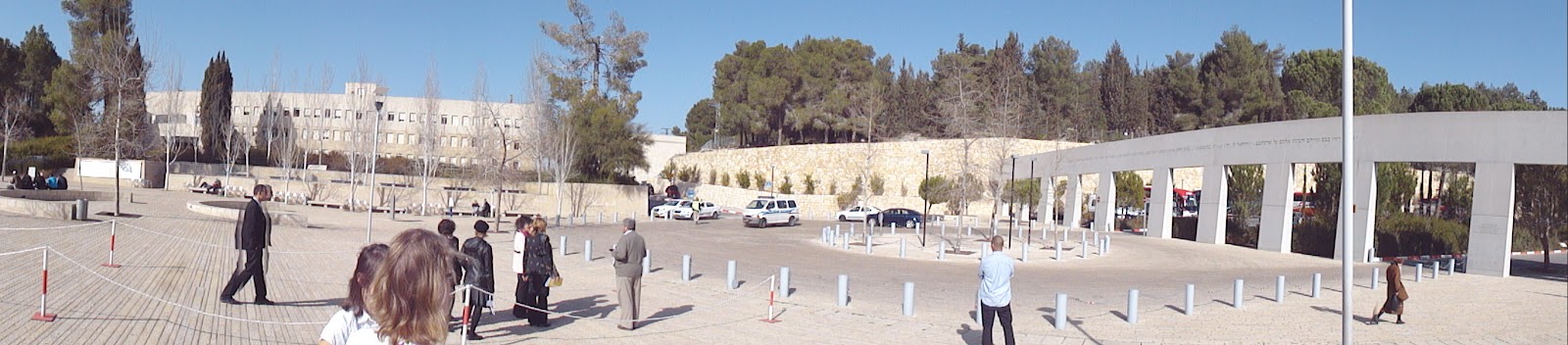
After class a group of us hopped on the tram system to Mt. Hertzel to visit and pay our respects to the victims of the Holocaust at the Yad vaShem Museum. This was my first time of the tram which I found out it is just a two way line and building it cost millions of dollars extra and the work was delayed a lot. But anyway going back to the museum, we entered the Gateway with a verse from Ezekiel 37:14 in English and Hebrew "I will put my Spirit in you and you will live, and I will settle you in your own land. Then you will know that I the LORD have spoken, and I have done it, declares the LORD." So far with just this verse and being in the chosen land, it has an somber and amazing (bad, not good) feeling. We walked through to the Garen of the Righteous where every tree in the garden and all over the museum grounds has plaque to each tree representing a gentile and or a resistance group who helped or tried to help the Jewish people to safety from extermination. We even found a tree in memory of Oskar Schindler, and this started to get real for me and I;m sure for the other as well. We walked on tot he Children's Memorial; where on the hill was a group of twelve or so limestone pillars of different heights representing the 1.5 million Jewish children from the little ones for the infants and the taller ones for the teenagers who had their live cut short and their family lines eliminated. 


Oskar Schindler's memorial


We went in the Memorial which was donated by a couple who lost their son from the concentration camps. Inside there was a large wall with portraits of the children killed and in the background was the recording of the 1.5 million children's names, age, and country which to complete the whole list would take 7 months continuously. The next room was pitch balk and the only light was from one candle reflected on a room of mirrors showing the light like millions of stars. Each star was to symbolize each child from infant to 18 years of age killed in the Holocaust. This part standing and hearing the names of the kids would were murdered and seeing the millions of lights was truly sad and I was starting to weep. We saw the Warsaw Memorial of large iron murals of the Jewish people being placed on train cars. And the Concentration camp hall, where on the floor was the names of the each concentration camps that took the lives of the millions of Jews and in the middle was a tomb of the unknown, which was filled with the ash of thousands of people and a everlasting flame. This too had a impact on me after seeing the camps names that I recognized from past history classes. We went on and toured the portrait hall of the portraits of people who were in the ghettos and camps right before they died. Seeing kids in the hall all the way to the eldery was a unspeakable and really I dont know what words to say, just a real way to see the victims of the Holocaust.


Aslo yesterday night was my night class, Church in the East. Where we learned to day about the Dhimma system which is a subgroup of the Sharia Law. A form of ingrained cultural, historical, and legal way of persecuting the Christians and Jews who live in Muslim territory. This form of forced contract is where the Christians and Jews have to pay a tax to live in Muslim regions, are not able to ride a horse, provide witness against a Muslim, wear clothes like a clown, and is subjected as a lesser people, even more inferior than the lowest class in Muslim tradition. This kind of tax they must pay is for any travel, and housing tax. Also any church or synagogue is owned by the Muslims and is taxed and the Christians/Jews must pay or bad things will happen. The pride of the Christian Church, the Church of the Holy Sepulchre is one of these, a Muslim family owns the Church property and is rented by the 4 Christian denominations. This form of persecution is killing the Eastern, the Syrian, and the Coptic Church so much that these Churches will be gone, extinct in roughly 50 years. So I ask all of you who are reading this to pray for the Eastern Churches for their growth/survival and for the love of Christ to change the Muslim ingrained culture of the Dhimma to a more reformed and equal, fair way of living. If this does not happen then there will be NO church in the East.